-
Shop
- Advanced Technologies
- AI Career Advantage Collection
- AI Skills
- AI Skills for Creators & Freelancers
- AI Client Management
- AI Ethics
- AI Mindset
- AI Tools & Prompts
- AI Writing & Content Creation
- Audio, Voice & Music
- Design & Visual Creation
- Email, Messaging & Communication
- Freelancing & Business
- Marketing, Ads & Conversion
- Productivity, Workflow & Automation
- SEO & Search Optimization
- Social Media Content & Growth
- Strategy, Planning & Analytics
- Video Creation & Editing
- AI Skills Mastery 2026 Collection
- Car Accessories
- Confidence
- Dating & Social Skills
- Digital Resources
- AI & Technology
- Beauty
- Budgeting & Saving
- Car Buying & Ownership
- Cozy Feast Collection
- Electronics & Technology
- Entrepreneurship & Business Growth
- Financial Education
- Financial Independence
- Financial Mindset & Psychology
- Goal Setting
- Home Styling & Organization
- Kitchen & Recipes
- Leadership
- Mindfulness
- Mindset
- Online Business
- Parenting & Child Development
- Personal Style & Fashion
- Pet Lifestyle & Wellness
- Positive Thinking
- Sleep Improvement
- Smart Life with AI
- Stress Management & Relaxation
- Travel Planning
- Wellness
- Yoga & Fitness
- Yoga & Mind-Body Practices
- Education & Learning
- Family & Parenting
- Fashion
- Accessories
- Alexander McQueen
- Bags
- Bags & Wallets
- Belts
- Blazers
- Bottega Veneta
- Bottoms
- Brunello Cucinelli
- Chloé
- Clothing
- Dolce & Gabbana
- Dresses
- Etro
- Hats & Hair Accessories
- Hoodies & Sweatshirts
- Jacquemus
- Jil Sander
- Kiton
- Luggage
- Miu Miu
- Off-White
- Outerwear
- Rick Owens
- Scarves
- Socks & Tights
- Sweaters & Cardigans
- The Row
- Tom Ford
- Tops & Shirts
- Valentino Garavani
- Vivienne Westwood
- Watches
- Fashion Accessories
- Furniture
- Gadgets
- Health & Beauty
- Health & Wellness
- Home & Garden
- Home Supplies
- Jewelry
- Kids & Babies
- Kitchen
- Kitchen Best-Sellers
- Lighting
- Luxury Brands Collection
- Online Business for Beginners
- Patio, Lawn & Garden
- Personal Growth
- Pet Care
- Pet Supplies
- Pets
- Shoes
- Smart Amazon Shopping
- Smart Home Living Guides
- Sport & Outdoors
- Super Deals
- TikTok Growth & Monetization Mastery
- Travel
- Travel & Adventure
- Wealth
- Popular
- Best deals
Exercise Motivation That Lasts: Habits Without Burnout
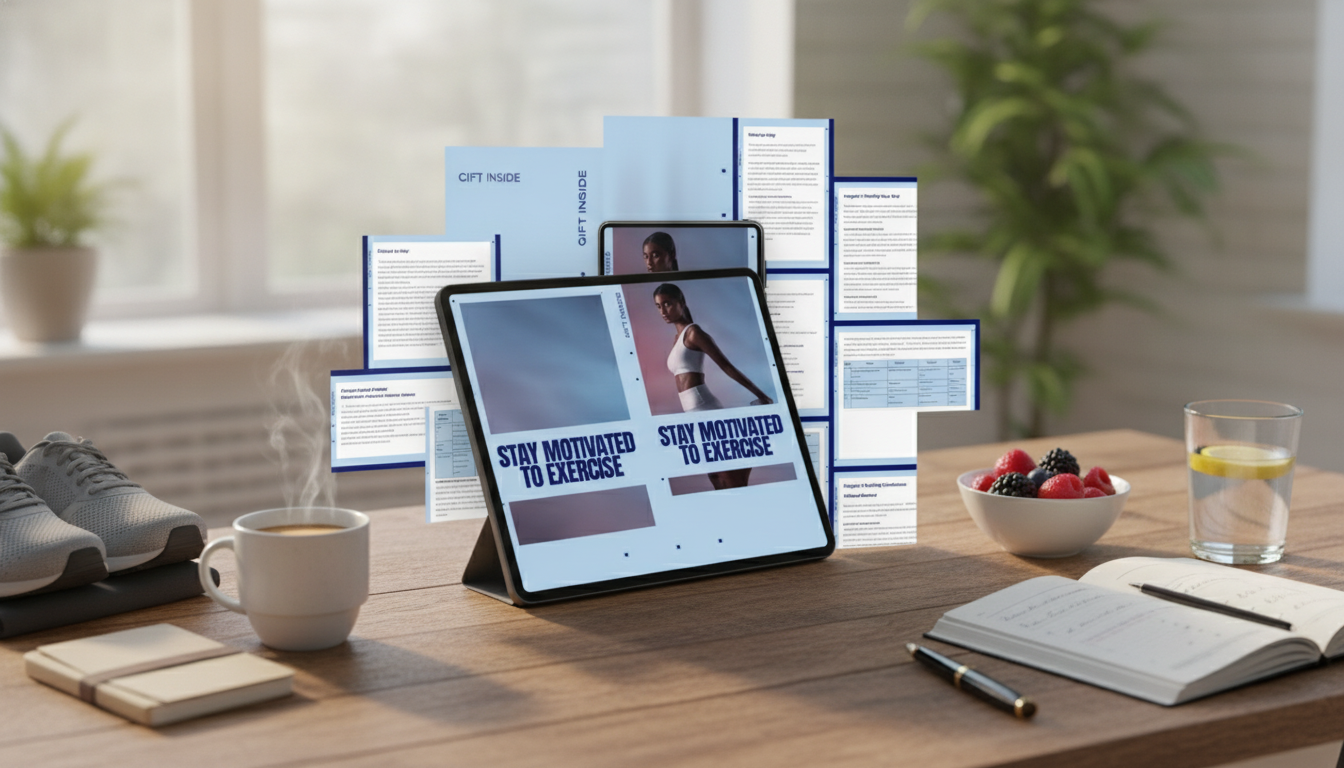
Stay Motivated to Exercise: Psychology-Based Consistency Without Burnout
Motivation isn’t a constant feeling—it’s a system. The most reliable exercise habits come from aligning goals, identity, environment, and recovery so workouts feel doable even on low-energy days. When the system works, you don’t need a huge “push” to get started—you just follow the next small step.
The goal isn’t to win every week. It’s to create a routine that survives busy seasons, stress, travel, and low sleep—while still moving you forward over time.
Start with the real reason motivation fades
Motivation usually doesn’t disappear overnight. It gets drained by predictable friction points that turn workouts into a high-stakes event.
- All-or-nothing planning: Expecting perfect weeks makes one missed day feel like failure—so quitting feels “logical.”
- Goals that are too vague or too big: “Get fit” doesn’t tell your brain what to do at 6:30 p.m. on Tuesday.
- Too much intensity too soon: Early soreness and fatigue can teach your brain that workouts equal discomfort and disruption.
- Decision overload: If every day requires choosing a new workout, willpower gets spent before you even start.
- Lack of immediate rewards: Long-term benefits are real, but your brain forms habits faster when there’s a quick “payoff.”
Consistency improves when you remove the drama: lower the bar to start, make the plan clearer, and keep the experience positive enough to repeat.
Build a motivation system: identity, cues, and rewards
Motivation becomes steadier when it’s connected to who you are, triggered by predictable cues, and reinforced by quick rewards. This aligns with autonomy and intrinsic motivation principles described in Self-Determination Theory (see the APA definition).
- Identity anchor: Pick a simple statement you can prove daily: “I’m someone who moves most days.” Then prove it with small actions.
- Cue design: Attach movement to something that already happens: after coffee, after work, after the school drop-off.
- Make the first step tiny: “Put on shoes” or “5-minute warm-up” counts as a win because it starts the chain.
- Immediate reward: Pair workouts with something enjoyable: a favorite playlist, a post-workout shower ritual, or a relaxing stretch.
- Track proof, not perfection: Count completed sessions per week—not an unbreakable streak that collapses after one miss.
The best reward is the one you can repeat. If the routine feels like punishment, the habit won’t stick.
Set goals that create action (not pressure)
Outcome goals can be inspiring, but process goals drive consistency. If you want workouts to happen even when life gets messy, aim for goals that tell you what to do this week.
- Use process goals: “3 sessions per week” is actionable; “lose 10 pounds” is delayed feedback.
- Create a minimum and a bonus: The minimum preserves the habit; the bonus captures high-energy days without guilt.
- Define success as showing up: Avoid tying self-worth to pace, weight, or reps.
- Plan a realistic progression: Small weekly increases in time or load are easier to sustain than big jumps.
- Write simple if-then plans: “If I’m late, then I do the 10-minute version.”
For health benchmarks, the Physical Activity Guidelines for Americans and the WHO physical activity guidelines are helpful references. Use them as direction—not as a perfection standard.
Use the Minimum–Target–Stretch method (weekly template)
This method reduces burnout because it builds flexibility into the plan. You always have a “floor” you can hit, a normal-week target, and optional stretch work that never becomes mandatory.
- Minimum: The smallest routine that still counts (protects consistency during stress).
- Target: Your normal-week plan (drives progress).
- Stretch: Optional extras for high-energy weeks (skipping them should feel neutral).
- Schedule recovery on purpose: Rest days and lighter sessions reduce dropout risk.
- Review weekly: If you repeatedly miss the target, lower it until it becomes reliable—then build again.
Example weekly plans that reduce burnout
| Level | Minimum | Target | Stretch |
|---|---|---|---|
| Beginner | 2 x 10-minute walks | 3 x 20–30 minutes (walk, bike, or beginner strength) | 1 extra walk + 10 minutes mobility |
| Intermediate | 2 x 20 minutes | 3–4 sessions (2 strength + 1–2 cardio) | Add short intervals or an extra strength accessory block |
| Busy/high-stress | Daily 5-minute movement | 2–3 sessions + 1 longer walk | Weekend hike or longer zone-2 session |
Make workouts easier by changing the environment
Environment is “motivation” you don’t have to think about. The more your surroundings guide you toward the next step, the less willpower you need.
Prevent burnout: train hard, recover harder (when needed)
When motivation disappears: a 10-minute rescue plan
Use a structured guide when willpower isn’t enough
For a step-by-step framework focused on motivation psychology and consistency without burnout, see the Stay Motivated to Exercise Guide.
If movement at home needs to be more playful (especially for families), the 6PCS Children’s Balance Stepping Stones can support short bursts of activity that feel like a game rather than a workout.
FAQ
How long does it take to build an exercise habit?
It depends on the person and the routine, but stable cues (same time/context) and a consistent minimum plan matter more than a specific number of days. Start with a version you can repeat even on busy weeks, then build gradually.
What should be done after missing a week of workouts?
Restart with your minimum plan immediately and avoid “punishment” workouts that spike soreness and make the next session harder. Identify what caused the break, then schedule your next 2–3 sessions on the calendar so the routine has a clear restart point.
How can consistency be maintained without burning out?
Use Minimum–Target–Stretch planning, schedule recovery days, and progress in small steps so fatigue doesn’t outpace adaptation. Deload when stress or soreness builds, and swap to lighter movement during high-stress periods to keep the habit alive.














Leave a comment