-
Shop
- Advanced Technologies
- AI Career Advantage Collection
- AI Skills
- AI Skills for Creators & Freelancers
- AI Client Management
- AI Ethics
- AI Mindset
- AI Tools & Prompts
- AI Writing & Content Creation
- Audio, Voice & Music
- Design & Visual Creation
- Email, Messaging & Communication
- Freelancing & Business
- Marketing, Ads & Conversion
- Productivity, Workflow & Automation
- SEO & Search Optimization
- Social Media Content & Growth
- Strategy, Planning & Analytics
- Video Creation & Editing
- AI Skills Mastery 2026 Collection
- Car Accessories
- Confidence
- Dating & Social Skills
- Digital Resources
- AI & Technology
- Beauty
- Budgeting & Saving
- Car Buying & Ownership
- Cozy Feast Collection
- Electronics & Technology
- Entrepreneurship & Business Growth
- Financial Education
- Financial Independence
- Financial Mindset & Psychology
- Goal Setting
- Home Styling & Organization
- Kitchen & Recipes
- Leadership
- Mindfulness
- Mindset
- Online Business
- Parenting & Child Development
- Personal Style & Fashion
- Pet Lifestyle & Wellness
- Positive Thinking
- Sleep Improvement
- Smart Life with AI
- Stress Management & Relaxation
- Travel Planning
- Wellness
- Yoga & Fitness
- Yoga & Mind-Body Practices
- Education & Learning
- Family & Parenting
- Fashion
- Fashion Accessories
- Furniture
- Gadgets
- Health & Beauty
- Health & Wellness
- Home & Garden
- Home Supplies
- Jewelry
- Kids & Babies
- Kitchen
- Kitchen Best-Sellers
- Lighting
- Online Business for Beginners
- Patio, Lawn & Garden
- Personal Growth
- Pet Care
- Pet Supplies
- Pets
- Shoes
- Smart Amazon Shopping
- Smart Home Living Guides
- Sport & Outdoors
- Super Deals
- TikTok Growth & Monetization Mastery
- Travel
- Travel & Adventure
- Wealth
- Popular
- Best deals
3-in-1 Self-Worth Toolkit for Confidence & Self-Esteem
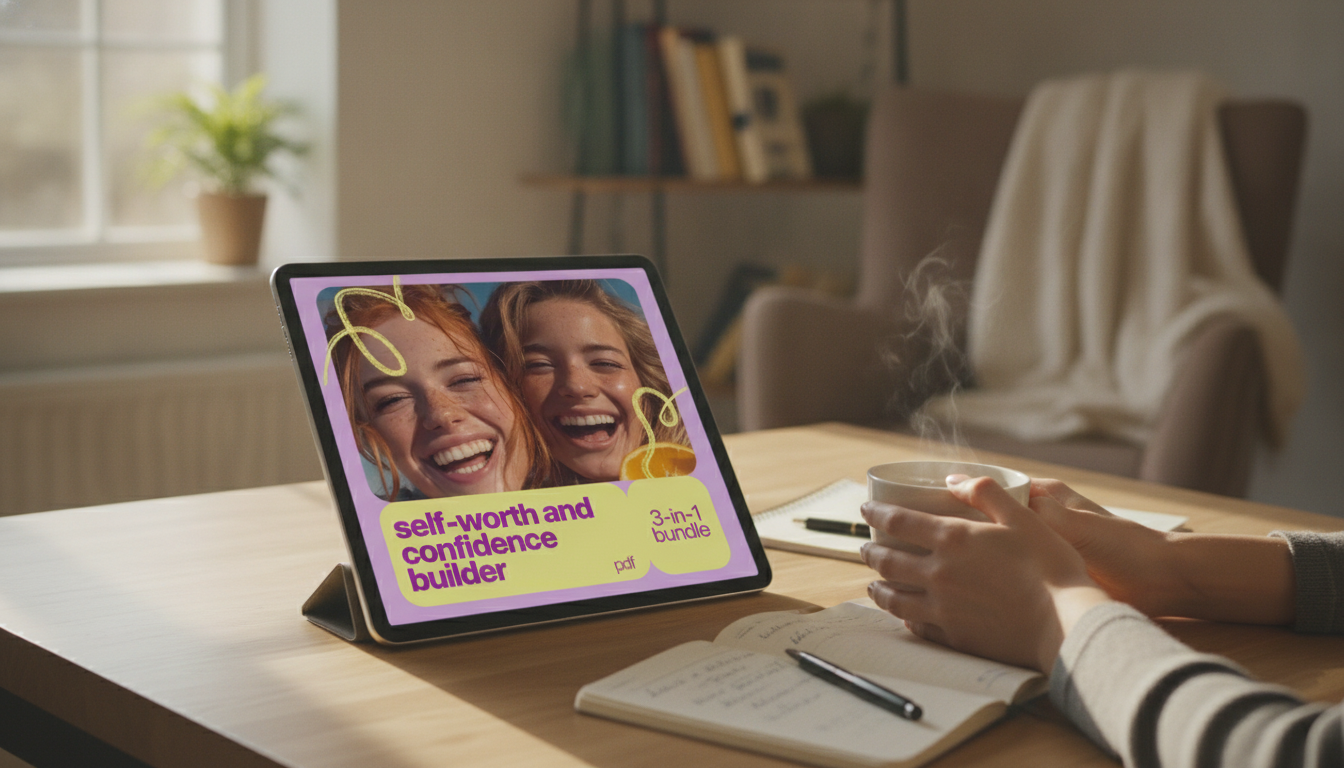
Self-Worth and Confidence Builder Toolkit: A Practical 3-in-1 Bundle for Stronger Self-Esteem
Self-worth and confidence can feel surprisingly fragile when stress is high, social comparison is loud, or old experiences start shaping today’s choices. A structured toolkit turns an abstract goal like “be more confident” into clear, repeatable practices—so progress is easier to notice, track, and keep going even when motivation dips. The right bundle supports healthier self-talk, steadier boundaries, and more consistent follow-through in everyday life.
What “self-worth” and “confidence” actually mean in daily life
Although they’re often used interchangeably, self-worth and confidence work differently—and strengthening both tends to create the most stable results.
- Self-worth is a steady sense of value as a person, even when performance, relationships, or moods fluctuate.
- Confidence is trust in your ability to handle specific situations—speaking up, starting something new, making decisions, or recovering after mistakes.
- Why both matter: confidence usually grows faster when self-worth is steadier; self-worth strengthens when actions align with values.
- Common signs of low self-worth: harsh self-criticism, people-pleasing, fear of mistakes, and discounting compliments.
Who benefits most from a confidence-building bundle
A bundle is especially helpful when you want a repeatable routine rather than occasional inspiration.
- People rebuilding after a setback such as a breakup, career change, burnout, or a move to a new environment.
- Overthinkers who know what to do but struggle to take consistent action.
- High achievers with imposter feelings and difficulty celebrating wins.
- Anyone who wants a system—prompts, exercises, and tracking—rather than relying on mood or motivation.
How a 3-in-1 toolkit supports real change
Confidence and self-esteem tend to improve most when insight and action work together.
- Structure reduces decision fatigue: the next step is already planned (prompt → exercise → reflection).
- Repetition rewires habits: consistent practice builds new default responses to triggers and self-doubt.
- Measurement makes progress visible: tracking small wins counters the brain’s negativity bias.
- A bundle covers multiple angles: mindset, behavior, and reinforcement—so you’re not relying on a single “breakthrough moment.”
For extra context on resilience and stress coping skills that pair well with daily practice, these resources are useful: American Psychological Association – Building your resilience, NHS – Self-esteem, and National Institute of Mental Health – Coping With Stress.
What’s inside the Self-Worth and Confidence Builder Toolkit bundle
The Self-Worth and Confidence Builder Toolkit – 3-in-1 Bundle to Boost Self-Esteem and Confidence is built as a multi-part system to support self-esteem, inner stability, and confident action over time.
- Guided exercises to identify unhelpful thought loops and replace them with realistic, supportive alternatives.
- Prompts for values, boundaries, strengths, and self-respect—especially helpful when you feel stuck or unsure where to start.
- Action-focused tools that turn insights into next steps, so confidence grows through practice rather than pressure.
A simple weekly routine using the toolkit (15–20 minutes a day)
Consistency matters more than intensity. A short daily rhythm helps you build proof—real-world evidence—that you can handle discomfort, speak up, and follow through.
- Day 1: Baseline check-in—rate confidence in three areas (work, relationships, self-care) and note the biggest trigger.
- Days 2–3: Thought and language reset—use prompts to reframe one recurring self-judgment into a balanced statement.
- Day 4: Boundary practice—choose one small “no” or one clear request; script it, then do it.
- Day 5: Competence loop—take one small action that proves capability (send a message, apply, practice, schedule).
- Day 6: Review—list three wins and what caused them (effort, preparation, courage).
- Day 7: Plan—pick next week’s focus area and set one realistic challenge goal.
Confidence micro-habits that pair well with the bundle
Quick picks: match a tool to the moment
| Situation | Helpful prompt/exercise | Goal for the next 24 hours |
|---|---|---|
| Comparing to others | List 3 personal values and 1 action that honors each | Do one values-aligned action instead of scrolling |
| Fear of speaking up | Write a 2-sentence boundary or request script | Use the script once in a low-stakes setting |
| Feeling like a fraud | Create an “evidence of competence” list (10 items) | Add 1 new piece of evidence today |
| Harsh inner critic | Reframe one self-judgment into a balanced statement | Repeat the balanced statement before a key task |
| Low motivation | Break one goal into the smallest next step | Complete the smallest step within 10 minutes |
What to look for when choosing a self-esteem toolkit
When extra support is a better fit than a toolkit alone
Product details and where to get it
- Product: Self-Worth and Confidence Builder Toolkit – 3-in-1 Bundle to Boost Self-Esteem and Confidence
- Price: $229.99 USD
- Availability: In stock
- Best for: building a repeatable routine that strengthens self-respect, boundaries, and confident follow-through
Optional add-on for a calmer daily reset
If your environment tends to keep your nervous system “on,” a simple comfort-focused reset routine can make daily confidence work feel more doable. The Turning Your House into a Glowing Retreat: Cozy Home Lighting Tips & Guides can complement your practice by helping you build an end-of-day wind-down space that supports consistency.
FAQ
How long does it take to notice changes in confidence?
Many people notice small shifts within 1–2 weeks when practicing daily, especially with win-tracking and boundary practice. Deeper self-worth changes often take several weeks of consistent repetition.
Is this toolkit better for self-worth or for confidence?
It supports both: self-worth practices stabilize how you relate to yourself, while confidence grows through guided action steps and measurable follow-through.
Can a self-esteem toolkit replace therapy?
It can be helpful for structure and daily practice, but it does not replace professional care—especially for trauma, severe anxiety, or depression.
















Leave a comment