-
Shop
- Advanced Technologies
- AI Career Advantage Collection
- AI Skills
- AI Skills for Creators & Freelancers
- AI Client Management
- AI Ethics
- AI Mindset
- AI Tools & Prompts
- AI Writing & Content Creation
- Audio, Voice & Music
- Design & Visual Creation
- Email, Messaging & Communication
- Freelancing & Business
- Marketing, Ads & Conversion
- Productivity, Workflow & Automation
- SEO & Search Optimization
- Social Media Content & Growth
- Strategy, Planning & Analytics
- Video Creation & Editing
- AI Skills Mastery 2026 Collection
- Car Accessories
- Confidence
- Dating & Social Skills
- Digital Resources
- AI & Technology
- Beauty
- Budgeting & Saving
- Car Buying & Ownership
- Cozy Feast Collection
- Electronics & Technology
- Entrepreneurship & Business Growth
- Financial Education
- Financial Independence
- Financial Mindset & Psychology
- Goal Setting
- Home Styling & Organization
- Kitchen & Recipes
- Leadership
- Mindfulness
- Mindset
- Online Business
- Parenting & Child Development
- Personal Style & Fashion
- Pet Lifestyle & Wellness
- Positive Thinking
- Sleep Improvement
- Smart Life with AI
- Stress Management & Relaxation
- Travel Planning
- Wellness
- Yoga & Fitness
- Yoga & Mind-Body Practices
- Education & Learning
- Family & Parenting
- Fashion
- Fashion Accessories
- Furniture
- Gadgets
- Health & Beauty
- Health & Wellness
- Home & Garden
- Home Supplies
- Jewelry
- Kids & Babies
- Kitchen
- Kitchen Best-Sellers
- Lighting
- Online Business for Beginners
- Patio, Lawn & Garden
- Personal Growth
- Pet Care
- Pet Supplies
- Pets
- Shoes
- Smart Amazon Shopping
- Smart Home Living Guides
- Sport & Outdoors
- Super Deals
- TikTok Growth & Monetization Mastery
- Travel
- Travel & Adventure
- Wealth
- Popular
- Best deals
Stay Calm When Plans Change: A 60-Second Reset
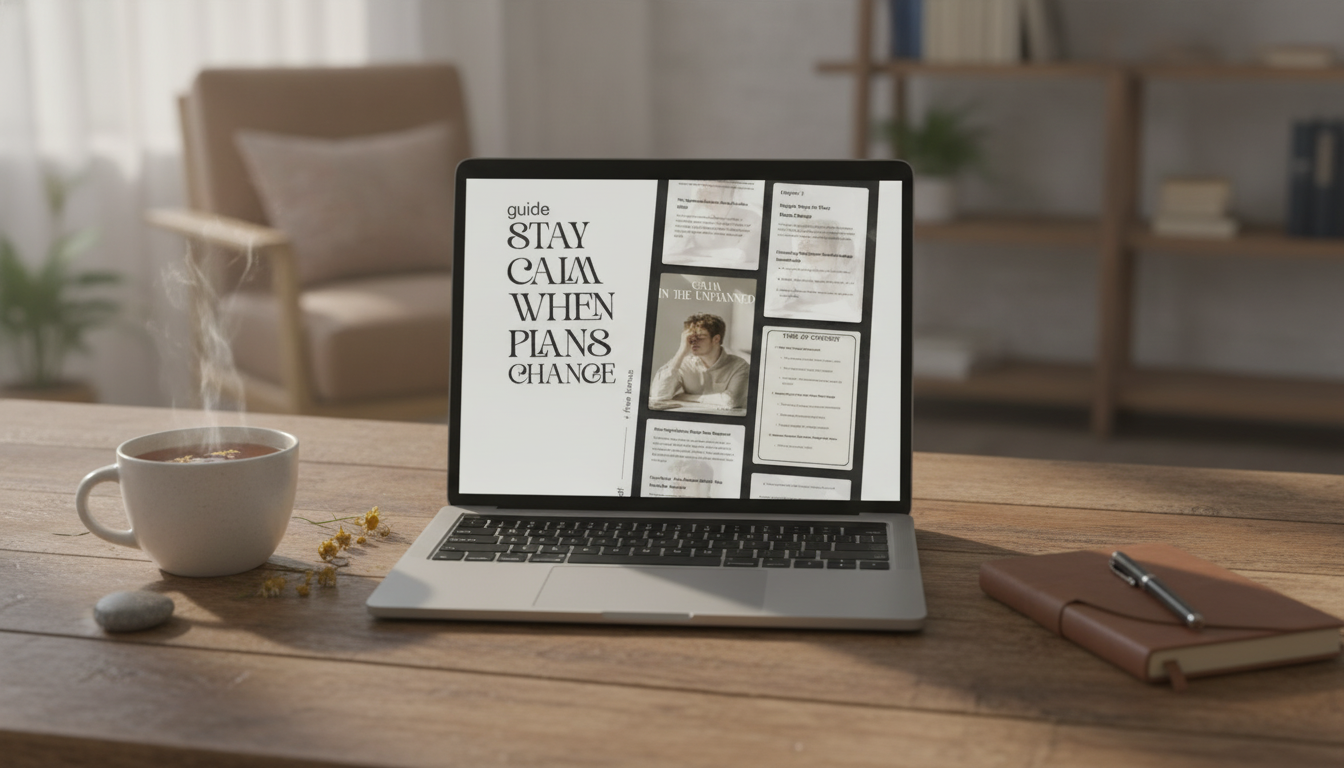
Calm in the Unplanned: Staying Steady When Plans Change
Plans shift, people cancel, timelines slip, and surprises show up at the worst moments. Calm isn’t about forcing life to cooperate—it’s the skill of meeting change without spiraling. With a few repeatable tools, a disruption can become a moment of clarity: regulate first, then respond. Below are practical mindfulness and resilience strategies designed for real life—work, relationships, travel, parenting, and everyday curveballs.
Why sudden change feels so intense
Sudden change hits hard because the brain treats uncertainty like a potential threat. Stress hormones rise, attention narrows, and the mind starts scanning for what could go wrong—often faster than conscious logic can catch up.
- Uncertainty can feel dangerous. When the outcome is unclear, the body prepares for the worst: faster heart rate, shallow breathing, and a “do something now” urge.
- Disrupted plans can trigger deeper fears. Loss of control, fear of judgment, and worries about future consequences can all show up in seconds.
- Stress often disguises itself as urgency. Rushing, over-explaining, irritability, or freezing are common “protective” reactions.
- Early awareness creates choice. Noticing the pattern (body → thoughts → behavior) gives a small pause where a calmer response can begin.
For a quick, science-informed overview of what stress is and how it affects the body, the APA Dictionary of Psychology entry on stress is a helpful reference.
A 60-second reset for the moment plans change
When the plan breaks, the goal isn’t to “feel great.” The goal is to stabilize the nervous system enough to make a useful next move.
- Pause and name the moment. Try: “This is a change. My body is reacting.” Labeling can reduce emotional intensity.
- Breathe low and slow. Inhale for 4 seconds, exhale for 6 seconds, for 5 cycles. Longer exhales nudge the body toward calm.
- Unclench. Soften your jaw, drop your shoulders, and relax your hands. Muscle tension signals “danger” to the brain.
- Orient to safety. Look around and identify 3 neutral details (a color, a shape, a sound). This widens attention beyond threat.
- Ask one stabilizing question. “What is the next smallest helpful step?”
Mindfulness practices don’t need to be long to be effective—especially when they’re simple and consistent. The NCCIH overview of meditation and mindfulness outlines approachable ways to build the skill.
Mindfulness skills that work under pressure
High-stress moments aren’t the time for complicated techniques. These tools are designed to work in 10–60 seconds, even when your mind is loud.
Micro-mindfulness
Give 10–20 seconds of attention to one anchor: the breath, the feeling of your feet on the floor, or a single sound. The point is not “empty mind,” but “one thing at a time.”
RAIN technique
- Recognize: What’s here (anger, panic, embarrassment)?
- Allow: Make room for it without fighting it.
- Investigate: Where do you feel it in the body?
- Nurture: Offer a kind inner response: “This is hard, and I can take one step.”
Thought defusion
Instead of “This is a disaster,” try: “I’m having the thought that this is a disaster.” That small shift creates space between you and the story.
Compassionate self-talk
Attention budgeting
Resilience habits that reduce reactivity over time
- Practice “flex planning.” Add buffer time, backup options, and a clear Plan B trigger (the moment you decide to switch).
- Build recovery rituals. A short walk, a glass of water, or a 3-minute breathing break after transitions prevents stress from stacking.
- Support sleep and movement. Consistent sleep and regular activity improve emotion regulation and stress tolerance. The American Heart Association’s stress management guidance includes practical ideas that fit busy schedules.
- Reduce decision fatigue. Pre-decide routines for mornings, meals, and workouts so surprises don’t drain capacity.
- Track wins. Write one line daily about a change you handled well. Your brain learns adaptability through evidence.
Common stressful scenarios and what to do next
| Situation | Typical stress reaction | Calming move | Next practical step |
|---|---|---|---|
| A meeting gets moved up | Rushing, scattered thinking | 4–6 breathing for 60 seconds | Confirm agenda + pick one deliverable to finish first |
| A friend cancels last minute | Rejection story, resentment | Name the feeling + soften body | Ask to reschedule or choose a nourishing solo plan |
| Traffic or travel delay | Anger, catastrophizing | Orient: 3 things you can see/hear | Check options, notify relevant people, conserve energy |
| A plan falls through at home | Overcontrol, snapping | Unclench jaw/shoulders + slow exhale | Switch to Plan B trigger you set earlier |
How to communicate calmly when plans change
A simple weekly practice for becoming more adaptable
A guided approach for stressful moments
- Calm in the Unplanned: Mindfulness & Resilience Guide offers clear exercises, quick resets, and realistic scenarios for everyday changes.
- Turning Your House into a Glowing Retreat: Cozy Home Lighting Tips & Guides can support a calmer baseline at home—helpful when your environment affects your nervous system.
- 6PCS Children’s Balance Stepping Stones can be a simple way to add movement-based regulation for kids (and adults), especially on high-energy, off-schedule days.
FAQ
Why do I get so anxious when plans change?
Uncertainty can register as a threat, which raises stress hormones and narrows thinking. A quick way to interrupt the spiral is a longer exhale (inhale 4, exhale 6) for five cycles to signal safety to your nervous system.
What is the fastest way to calm down in the middle of a disruption?
Use a 60-second protocol: label the change, do 4–6 breathing, relax jaw/shoulders/hands, orient to three neutral details around you, then choose the next smallest helpful step.
How can I stop snapping at people when things don’t go as planned?
Pause and breathe before speaking, then use a simple template: “Here’s what changed. Here’s what I can do. Here are two options.” If you do snap, repair quickly with one sentence that names your stress and restates your boundary calmly.















Leave a comment